
Santa Fe County Arrest Records and Charges
Santa Fe County arrest records begin on the law-enforcement and jail side. The Santa Fe County Sheriff's Office, led by Sheriff Adan Mendoza, handles sheriff incident reports, warrant activity, arrests by deputies, civil process, and sheriff records requests. The county Corrections Department, not the sheriff, runs the Adult Correctional Facility and the public jail roster. A sheriff hot-sheet entry can show a warrant arrest, deputy, location, charge wording, and booking note, but it is not the final court file.
Charges after arrest are narrower than the full criminal case file. The charge record is the formal list of alleged offenses, often tied to a statute, degree, agency, bond, citation, warrant, or case number. The full case later adds hearings, plea papers, motions, disposition, sentence, probation, and financial obligations. For current custody and booking fields, use the Santa Fe County inmate records path. For the case outcome, sentencing, and final docket, use the criminal court record after the charge has been filed.
The Sheriff's Office public page shows the official public-safety contact points. See the Santa Fe County Sheriff's Office source page before using a sheriff record as proof of a court outcome.
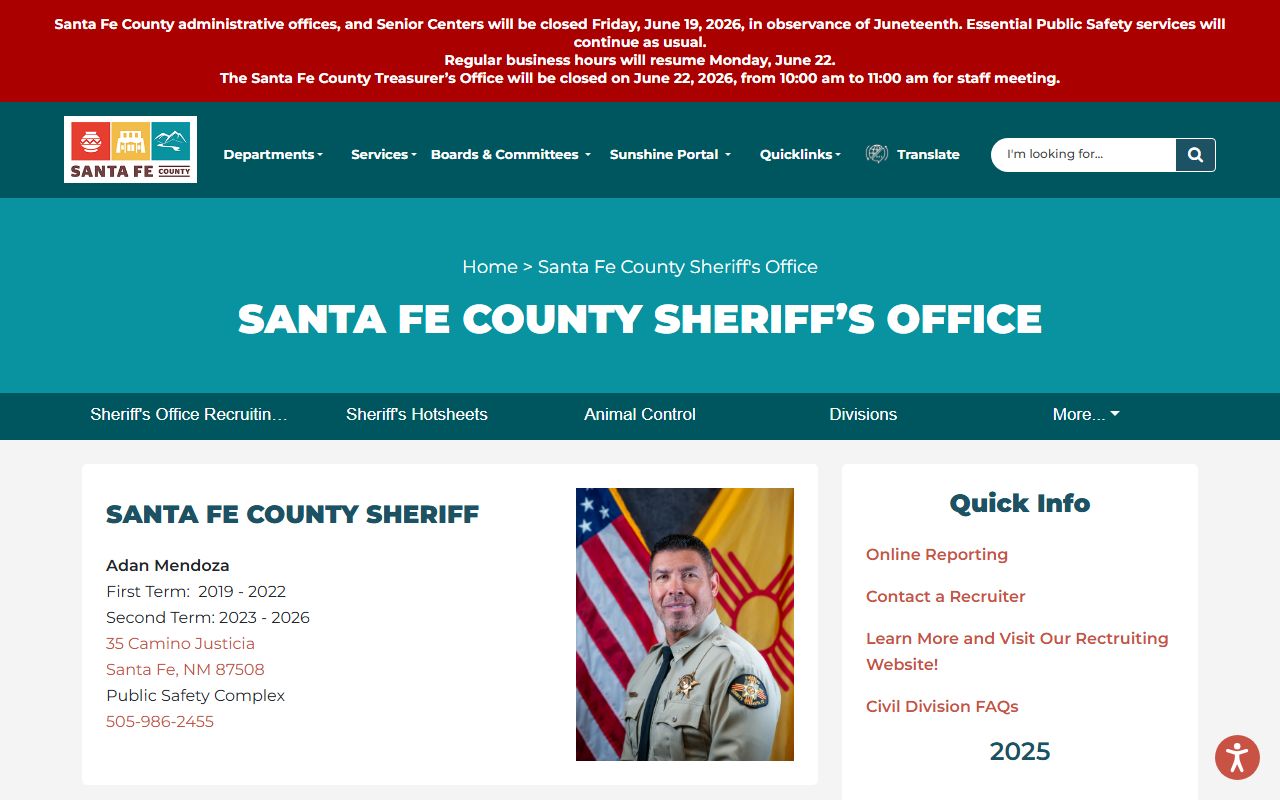
The sheriff source is useful for records requests, division numbers, and OffenderWatch access, while the court record is still needed to confirm what charge was filed and how it ended.
Search Santa Fe County Arrest Records
There is no single Santa Fe County mugshot or arrest-to-conviction database that answers every question. Start with the record type that matches the question. For a recent deputy arrest or warrant arrest, use the Sheriff's hot sheets and the Sheriff's records custodian at shfrecordsreq@santafecountynm.gov. For current custody, use the county inmate lookup. For filed court charges, use New Mexico Judiciary Case Lookup, Santa Fe Municipal Court, or the First Judicial District Court Clerk's Office.
- Check the Sheriff's hot sheets for a dated arrest or warrant-arrest summary when the event may have involved a deputy.
- Search the county inmate lookup if the person may still be held at the Adult Correctional Facility.
- Use New Mexico Case Lookup by defendant name or case number for District, Magistrate, appellate, and limited Municipal Court records.
- Review the charge list, statute, charge level, bond entry, warrant event, and court where the case is pending.
- Contact the court clerk or sheriff records custodian if the public web entry is missing, stale, sealed, or too thin for the intended use.
Santa Fe Municipal Court matters may need a separate search through the city's FullCourt public portal. That portal supports party, attorney, officer, police reference number, vehicle plate, and docket-number searches. A city traffic or ordinance arrest may therefore show in a municipal record rather than a District Court case.
Santa Fe County Charges After Arrest
After an arrest, the prosecutor decides what, if anything, to file in court. The First Judicial District Attorney serves Santa Fe, Rio Arriba, and Los Alamos counties and prosecutes state criminal cases. District Attorney Mary Carmack-Altwies' office is at 327 Sandoval St., Santa Fe, NM 87501, with phone 505-827-5000 and email 1stda@da.state.nm.us. The DA may file charges, request pretrial detention in District Court, work with victim advocates, and later amend or dismiss charges when the facts or law require it.
| Charging Paper | Who Files It | Where It Appears | Santa Fe County Use |
|---|---|---|---|
| Complaint | Law enforcement or prosecutor | Magistrate, Municipal, or District Court | Common starting point for misdemeanor, DWI, traffic, and early felony proceedings. |
| Information | Prosecutor | District Court criminal case | Formal prosecutor-filed felony charging document after screening or preliminary process. |
| Indictment | Grand jury | District Court criminal case | Felony charging document returned by a grand jury when that route is used. |
First Judicial District Attorney public materials show how prosecution policy and case filings shape court charge records. The FJDA shoplifting source page is one example of a local prosecution topic that can produce filed charges rather than a mere arrest note.
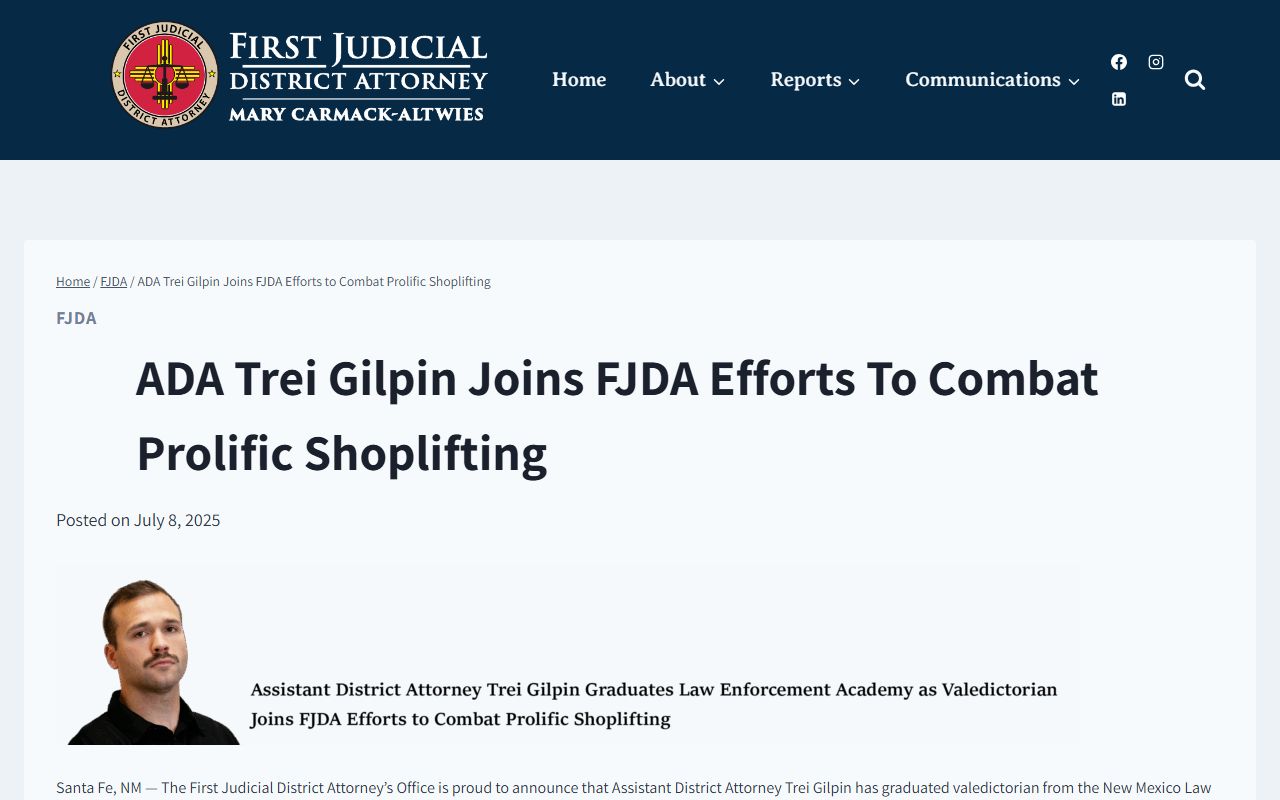
DA source pages are not a substitute for the clerk's docket, but they help explain why a charge may be screened, filed, amended, or pursued with a specific public-safety focus.
Santa Fe County Charge Status
A Santa Fe County court charge may change many times. A charge can be pending at arraignment, amended after review, reduced in a plea, dismissed by the court, dismissed by the prosecutor, or replaced by a different count. Case Lookup and clerk records should be read at the charge level, not just at the case level, because one arrest can produce several counts with different outcomes.
| Status | Meaning in a Charge Record | Where to Verify |
|---|---|---|
| Pending | The charge has been filed and no final outcome is shown yet. | Case Lookup, docket, or issuing court. |
| Amended or reduced | The charge wording, statute, or severity changed after filing. | Later docket entries and charging papers. |
| Dismissed | The count or case was ended without a conviction on that count. | Disposition entry, order, or clerk copy. |
| Convicted | The defendant was found guilty or entered a guilty or no-contest plea. | Disposition and sentence documents. |
| Warrant or FTA event | The court issued or recalled a warrant for nonappearance or noncompliance. | Court docket, warrant division, or jail roster if arrested. |
The sheriff hot-sheet source shows incident summaries with arrest and charge terms. Use the Sheriff's hot sheets source page as a lead into the records chain, then confirm prosecution status in court.
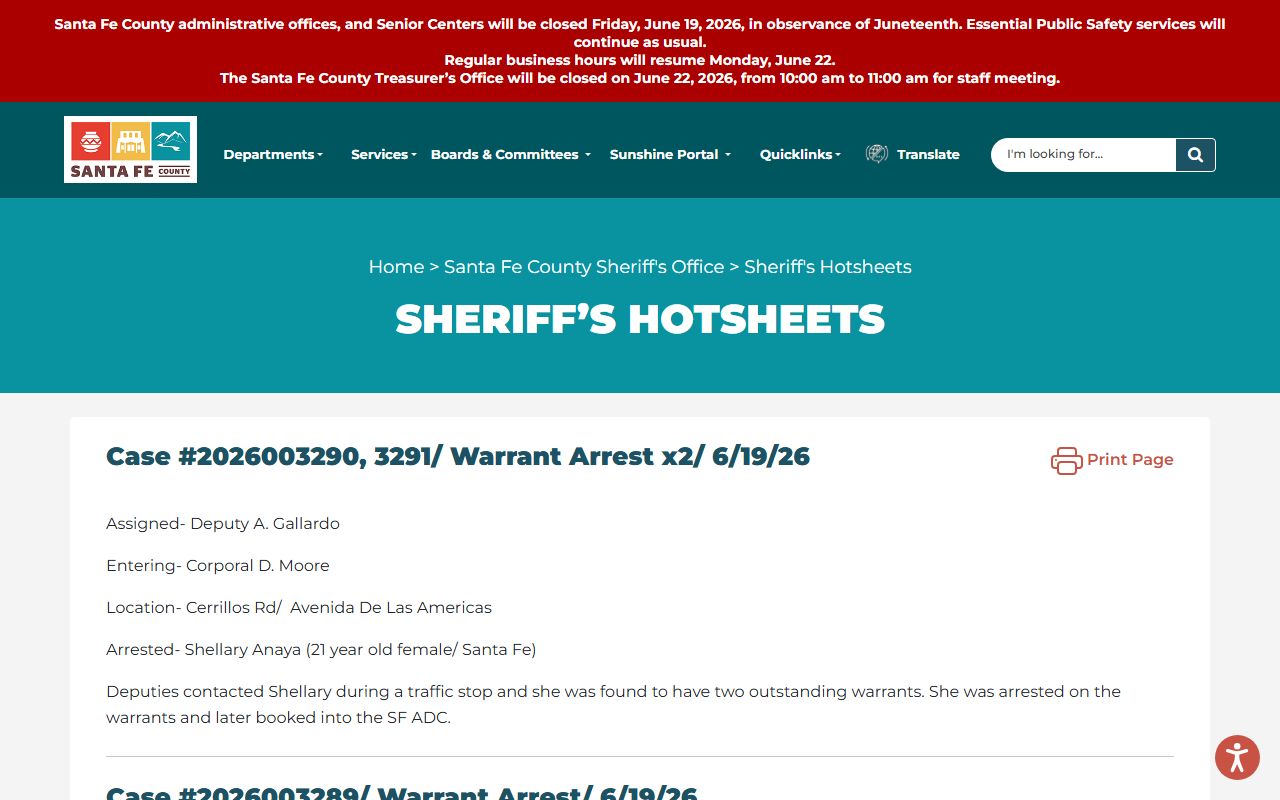
Hot sheets can point to a recent event, but they do not show every later amendment, plea, dismissal, or sentence entered by the court.
Santa Fe County Charges vs Convictions
A charge is an accusation. A conviction is an outcome. Santa Fe County court records may show charges that were never proved, were dropped, were dismissed, or were changed to a different offense. This distinction matters for employment, licensing, housing, immigration, and personal record review because a booking or hot-sheet entry can remain visible even when the court case later ends without a conviction.
| Issue | Charge | Conviction |
|---|---|---|
| Stage | Filed after arrest, citation, complaint, information, or indictment. | Entered after guilty plea, no-contest plea, or trial verdict. |
| Proof | Based on probable cause or prosecutor screening. | Based on a plea or proof beyond a reasonable doubt. |
| Record location | Charge list, docket, hot sheet, jail roster, or citation record. | Disposition, judgment, sentence, and state driver or criminal history record when applicable. |
| Risk of error | May look final when it is only pending. | May still require certified copy or court confirmation. |
Public Access to Santa Fe County Charge Records
New Mexico law favors public inspection, but arrest and charge records have limits. NMSA 1978 Section 14-2-1 is the core Inspection of Public Records Act right to inspect public records unless an exception applies. Section 14-2-1.2 allows some law-enforcement material, confidential sources or methods, and uncharged-accused information to be withheld or redacted. Rule 1-079 NMRA governs public access to District Court records and allows limits by rule, statute, or written order.
For sheriff records, email shfrecordsreq@santafecountynm.gov and ask for identifiable public records rather than a broad background check. For court charges, inspect the file with the clerk where the case was filed or use the New Mexico Courts IPRA path at ipra.nmcourts.gov. Written First Judicial District requests may be mailed to the Records Custodian at P.O. Box 2268, Santa Fe, NM 87504, and should describe the records with reasonable detail. The court copy fee listed in the research is $0.35 per page.
Note: New Mexico Case Lookup is for individual electronic court-record viewing and prohibits bulk or unauthorized database use.
Restricted Santa Fe County Arrest Records
Not every Santa Fe County arrest record or court charge is public. Juvenile criminal cases are no longer displayed on Case Lookup, and NMSA 1978 Section 32A-2-32 makes juvenile delinquency-related records and many youth reports confidential. Family Violence Protection Act order-of-protection cases are also no longer displayed on the public Case Lookup site. Sealed records, expunged records, mental-health materials, protected identifiers, and some ongoing law-enforcement records may be hidden or redacted.
New Mexico's Criminal Record Expungement Act allows eligible arrest and conviction records to be removed from public view by District Court order after statutory conditions are met. The public record should not be treated as complete when a charge is sealed, expunged, juvenile, or otherwise restricted. Court and sheriff offices may deny or redact records when a statute, court rule, or written court order limits public access.
The county youth-program source is tied to restorative pathways. The Uplift youth program source page reflects why juvenile and youth-related material must be handled with care.

Youth program information can explain process and context, but juvenile arrest, charge, and behavioral records remain subject to strict confidentiality rules.
Santa Fe County Charge Help
People with active charges should confirm the issuing court before acting. Municipal traffic or ordinance matters often route through Santa Fe Municipal Court. Misdemeanor, DWI, traffic, and felony preliminary matters may route through Magistrate Court. Felony cases and pretrial detention motions often move to District Court. The DA's pretrial detention page explains that intake screens cases for detention, the motion is filed in District Court, a hearing occurs, and a judge grants or denies detention.
The New Mexico Law Offices of the Public Defender has a Santa Fe Trial and Administration office at 301 N. Guadalupe St., Ste. 200, Santa Fe, NM 87501. The office serves Santa Fe, Rio Arriba, and Los Alamos counties, can be reached at 505-395-2888, and accepts eligibility applications on weekdays. If a court appointed a public defender and the person is in jail, assignment is automatic; if appointed and not jailed, the person must go to the closest public defender office and apply. The official application page notes a $10 cash or money order application fee.
Recent First Judicial District Attorney source pages show how filed charges can move through public prosecution updates. The State v. Flores-Torres source page is another example of a court charge becoming part of a public criminal case record.
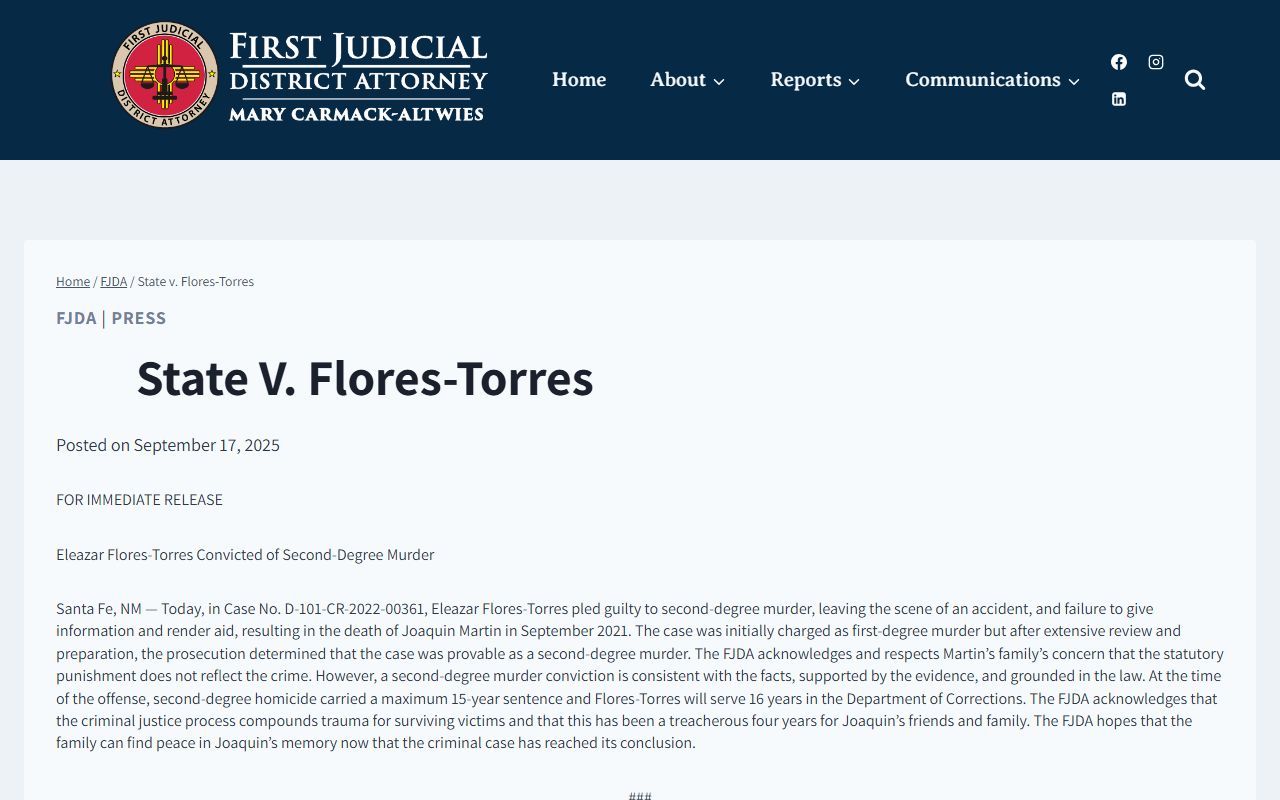
Press releases can identify public case context, but certified charge status still comes from the court clerk and official docket.